
Look on my works, ye mighty, and despair. Ozemandias. Shelley. I don’t think I could live in that building. I’d be too afraid it would topple.
Aaah, I feel better today. I was able to get quite a few hours of continuous sleep last night and awoke reasonably refreshed. And I’m pretty sure I know why I slept properly – no alcohol after about 7pm. Especially no mixed drinks, i.e. beer plus red wine. That’s a pity. Maybe I’ll try white wine to see if it has the same detrimental effect. Or prosecco – I do like that. Poor man’s champagne.
________________________________________________
Strange, I’m still using Ozempic (semaglutide) the “fullness”” drug, and although I was having excellent success last year, losing 6kg, since Xmas it doesn’t seem to be working. That is, I still feel hungry. And paradoxically, I even feel food cravings. My weight has risen by a couple of kilos and is not going down. Bugger.
I guess the answer is that you have to use a bit of will power (or ‘won’t’ power) as well as the drug. That’s not easy, whereas the weight loss before Xmas seemed effortless. Oh well, shoulder to the wheel.
________________________________________________
My partner bought me a book for my upcoming birthday (bless her) called Interstellar Travel. She heard me thinking aloud about it, something I’ve been thinking about for years. I have ideas about it:
- I believe we’re kind of quarantined in the Universe, by some kind of natural design. A bit like a beetle placed in a deep bowl. No matter how much it tries, it can’t climb the walls of its container. There’s a whole world outside, as we know, but the beetle will never be able to see it or visit it.
- I think there’s a reason behind this: it’s so that each civilisation in the Universe (and I belive there are many, many, in fact countless civilisations), can’t “contaminate” other cultures. We are not meant to visit other civilisations. We are in a gravity “bowl” and are never going to be able, like the beetle, to climb out.
- The speed of light is unbreakable, an absolute limit. Nothing, not even light, can travel faster than 3.0 x 10⁸ metres/second. That also means information. Since we can never even approach that speed (our mass increases according to m = F/a (F=ma) then the faster we accelerate (a), the bigger our mass (m) increases and therefore the force (F) required, so as to limit our velocity. The idea of a spaceship approaching or exceeding the speed of light is ridiculous, according to our present knowledge, anyway. It’s possible there may in the future be some breakthrough in the laws of physics, but it’s very doubtful.
- Even if we did decide to travel to our nearest star, and could build a spaceship capable of such a trip, it would take at least 200 – 300 years even if we could travel at a fraction (maybe 10%) of the speed of light. That means the crew and travellers in that ship would have to live and die on the ship, and breed at least one new generation in the ship. Yes, have sex and give birth to a new crew, at least once. Just think of the sociological and psychological implications. The parents would know that they would never see Earth again, nor would their children, but they would need to be educated with all the human social knowledge required to live lives in the service of the Goal, to reach the new star.
- But what if the children and young adults rebelled? What if they didn’t care about the Goal? What about the potential for serious rebellion, even warfare between the true believers and the rebels? The ship would need to be vast, so could there be a form of segregation?
- While the spacecraft is on it’s century or more long voyage, research and development on Earth will not stand still and there is every possibilty that when the present day craft finally arrives, there may be a welcoming committee on the new planet to greet them, having arrived decades before. This would be extremely upsetting for the slow voyagers, having thought they would be the first.
- Relativistic effects would mean that time would pass much more slowly for the voyagers compared to Earth time, meaning that the people on Earth would age much faster. Therefore the voyagers would have to accept that their parents and loved ones left on Earth would age and die during the voyage. So they would need to accept that they would not see or be able to talk to their families again.
- Even communicating with Earth would become almost impossible as the voyage went on. At present, signals from the farthest man-made objects, Voyager 1 and 2, tiny spacecraft launched in the 1970s and presently past Pluto, outside the Soar system, take more than three hours to reach Earth. It would take days, weeks or months for signals from an interstellar spacecraft to reach Earth, meaning the voyagers would be “on their own”, with virtually no news or hope of messages from Earth. This would be an enormous psychological hurdle.
- Huge strides have been made in electronic and mechanical reliability in the past few decades, but reliability measured in centuries? It’s not feasible at the moment. At present, electronics will last decades, but no-one can predict what will happen over century time scales.
In other words, I don’t believe we are at the required level of reliability, and won’t be for a long time.
Huges strides have been made in electronic and mechanical reliability in the past few decades, but reliability measured in centuries? It’s not feasible at the moment. At present, electronics will last decades, but no-one can predict what will happen over century time scales. - So what happens when (not if) components break down and go faulty? How many spares can the spaceship carry? What would happen if spares ran out? Who would do the diagnosis and repairs? Would the training facilities on the spaceship be able to train the next generation of technicians, and the next? Would there be a new generation willing to take on the training and responsibilities? Probably yes, but probably is not enough, we would need certainty.
In other words, I don’t believe we’re at the required level of reliability, and won’t be for a long time. - What about food? Providing for a crew of probably at least 100 people for up to two centuries will require innovative ideas. Obviously, crops requiring large areas of soil will be difficult. It will be possible to use vast areas of hydroponic crops – we already know how to do this. Animals? Unlikely. The requirements for grazing areas, waste disposal, slaughtering areas, animal husbandry would likely be too onerous. Better to use artificial growth for meat, as we can do already. However, this is another area where reliability will be critical.
It’s one thing to manufacture the required food on board the ship, but variety and innovation will be critical. Imagine needing to eat the same diet, even if rotating on a weekly basis, for 100 years.
I could go on, but the last point I want to raise is motivation. The first crew and passengers will know that theirs is a one way trip and they will never see the destination. They will die on board, hopefully of natural causes.
But this would be a daunting prospect. It would require a high degree of altruism to know that you are sacrificing your life and that of your family without ever seeing the fruits of your sacrifice.
So a new generation would need to be born on the ship and be taught the objective of the voyage. Popular fiction always shows the crew being in a state of suspended animation, frozen in a deep sleep, but the fact is that we don’t know how to do this. Maybe it will become routine in 50 years or so, but there’s no guarantee of this. And reliability must be factored in again. The cryogenics would need to be 100% reliable. We can never guarantee this.
So I reiterate, I can’t see this human race venturing out of the Solar System to other planets around distant stars in our lifetimes. I’m always open to the thought that some astounding breakthroughs will be made in the next 50 – 100 years which will negate my objections, but I’d be very surprised.
_________________________________________
The other day I found a query on the web: if we set out to travel in a straight line into interstellar space, would we go on forever, or loop around and return to our starting point (even if it took a very, very long time)? This was what a very knowledgable person wrote in answer:
Despite all the possibilities that account for the shape, curvature, and topology of the Universe, traveling in a straight line, even forever, can never return you to your starting point. The combined facts that:
- the Universe is expanding,
- dark energy is causing the expansion to accelerate,
- it’s already 13.8 billion years after the Big Bang,
- and the Universe does not repeat and is not finite on scales smaller than ~46 billion light-years,
ensure that we’ll never be able to circumnavigate the Universe the way we can circumnavigate the Earth. The Universe may, on some very grand cosmic scale, truly be finite in nature. But even if it is, we’ll never be able to know. While we can travel through space as far as we like, as fast as we can, for as long as we can imagine without end, most of what’s in the Universe is already forever beyond our reach. There is a cosmic horizon that limits how far we can travel through the expanding Universe, and for objects more than ~18 billion light-years away at present, they’re already effectively gone.
So there you go. Or there you went. Whatever.
_______________________________________________
Finally:
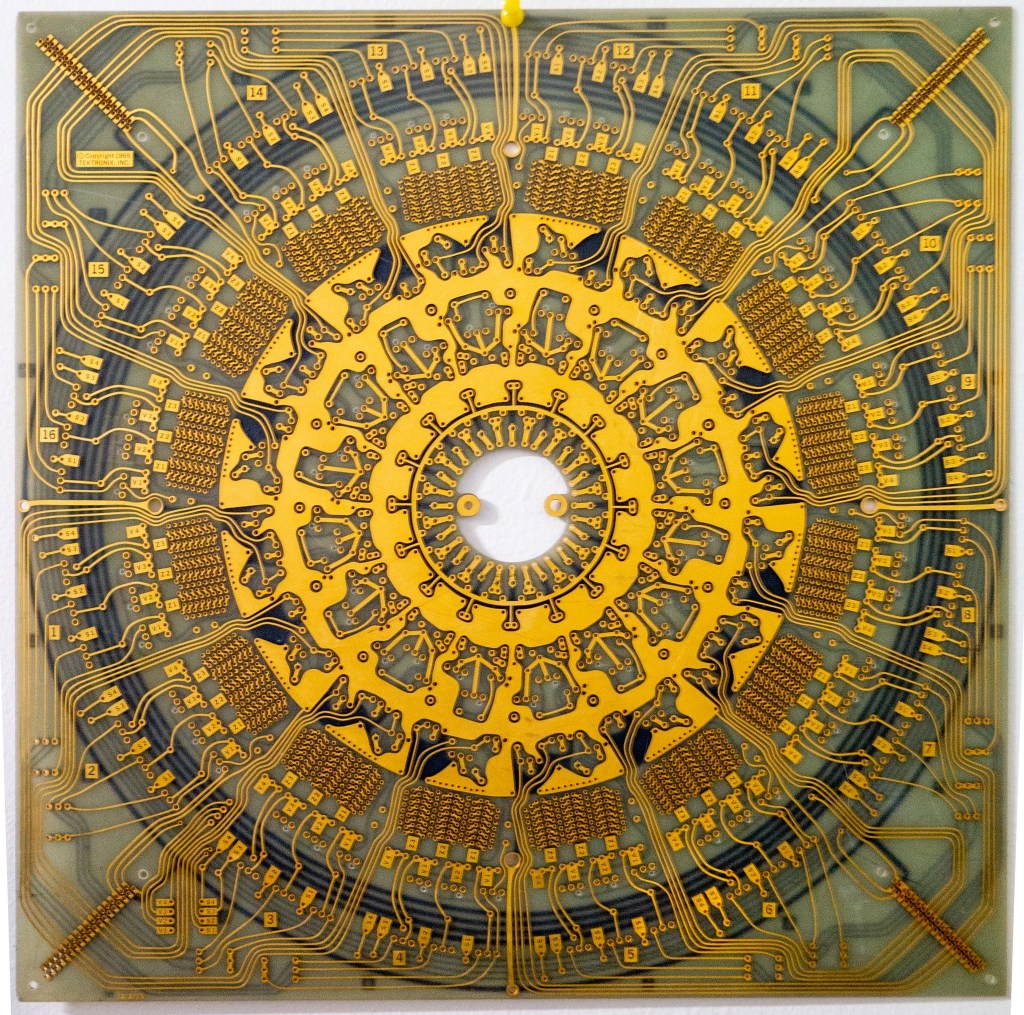
What is it? It’s a printed circuit board made by Tektronix, a USA company that makes ultra high end electronic test equipment. I used to use a lot of their gear in my days at Channel 7.
I believe this is the base PCB for a large test array. You can see the sockets for extra assemblies in the corners. I think it looks fantastic. This is 1960s technology, by the way, long outdated and obsolete.
 Bull's Roar